Historic Masonry Re-pointing in Philadelphia: The Science of Lime MortarPhiladelphia is a city built of brick. From the 18th-century town-homes of Old City and Society Hill to the endless miles of 19th-century rowhomes across South Philly, North Philly, and West Philly, historic brick masonry defines the urban landscape.However, brick facades require periodic maintenance. Over decades of rain, frost, and thermal expansion, the mortar joints between the bricks slowly erode.
When mortar crumbles, water penetrates the wall, causing interior plaster damage and structural decay.When faced with deteriorating masonry, well-meaning homeowners often hire general contractors who make a catastrophic mistake: re-pointing historic brick with modern Portland cement.At Philadelphia Exterior Contractors, we specialize in historic building envelope preservation. Here is the critical material science behind historic brick re-pointing and why using the correct mortar formula is vital to saving your home.The Chemistry of Historic Brick vs.
Philadelphia Exterior Contractors — official website.
Philadelphia L&I: Building Permits.
Modern CementTo understand re-pointing, you must understand how historic masonry walls function.Historic Philadelphia bricks (produced before 1920) were clay-molded and fired at relatively low temperatures in coal-fueled kilns. These historic bricks are comparatively soft, porous, and breathable.The mortar used to assemble these historic bricks was composed of slaked lime and sand—a mixture that cures softly and remains slightly flexible throughout its lifespan.The Rule of Sacrificial MortarIn a historic masonry wall, the mortar is designed to be the “sacrificial” element.Moisture Migration: Water naturally enters a brick wall.
A breathable lime mortar allows that moisture to migrate harmlessly to the surface and evaporate.Thermal Movement: As temperatures shift between summer heat and winter freezes, the bricks expand and contract. Soft lime mortar absorbs this movement like a cushion.Sacrificial Wear: Over 50 to 100 years, the soft lime mortar slowly erodes, protecting the harder bricks. It is cheap and easy to repoint mortar; it is expensive to replace broken bricks.The Disaster of Modern Portland CementIn the mid-20th century, modern Portland cement (Type S or Type M mortar) became the construction standard.
Modern Portland cement cures into an extremely hard, dense, and non-porous material.When an inexperienced mason uses hard Portland cement to repoint a soft historic brick wall, the structural mechanics are destroyed:Trapped Moisture: Portland cement is non-porous. Water entering the wall can no longer evaporate through the mortar joints. It gets trapped inside the soft historic bricks.Spalling Brick Damage: During a Philadelphia winter, that trapped water freezes inside the brick. As ice expands, it exerts immense internal pressure.
Because the modern Portland cement mortar joints are rock-hard and will not yield, the pressure explodes outward through the face of the brick. The hard outer shell of the historic brick pops off—a devastating, irreversible structural failure known as spalling.Stress Cracking: Because hard cement cannot absorb thermal expansion, the movement of the building forces the soft historic bricks to crack directly down the middle rather than flexing along the mortar joints.+——————————————————————-+
| LIME MORTAR VS.
PORTLAND CEMENT |
+————————————+——————————+
| Lime Mortar (Type O / Historic) | Soft, breathable, flexible; |
| | protects soft historic brick.|
+————————————+——————————+
| Portland Cement (Type S / Type M) | Extremely hard, non-porous; |
| | causes historic brick spall. |
+————————————+——————————+
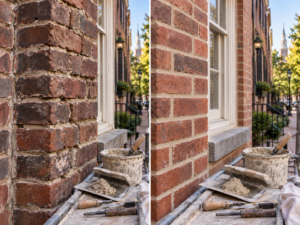
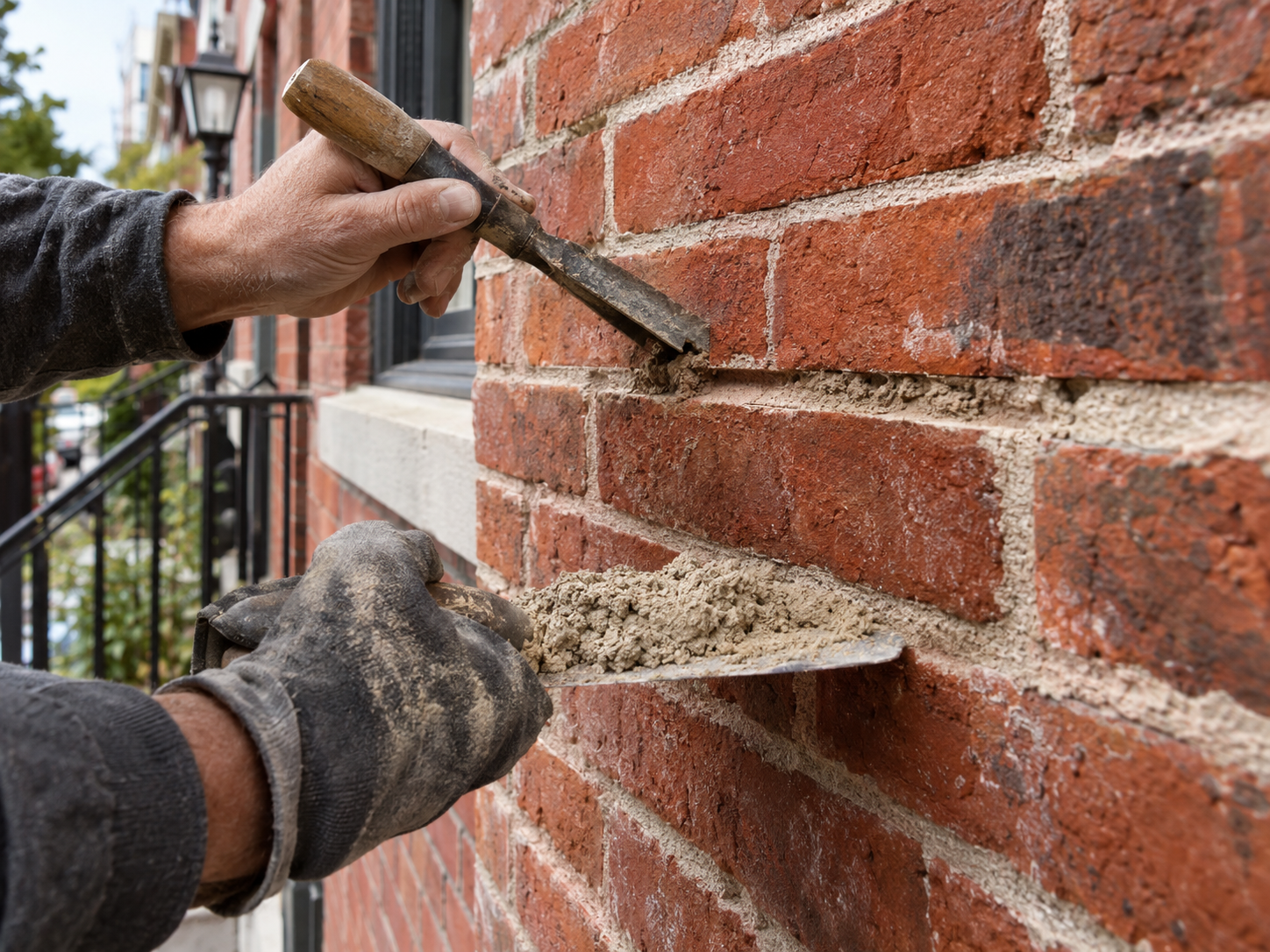
The Re-pointing Process: Meticulous CraftsmanshipRepointing a historic facade is a labor-intensive art governed by strict preservation standards, such as National Park Service Preservation Brief 2.Step 1: Raking Out the Old MortarThe damaged, crumbling mortar must be removed to a uniform depth (typically 2 to 2.5 times the width of the mortar joint, or until sound mortar is reached).Hand Tools over Angle Grinders: Inexperienced workers use heavy angle grinders with diamond blades, which frequently slip and cut deep, permanent gashes into the edges of the historic bricks.
Historic re-pointing requires delicate hand chisels, pneumatic raking tools, or small diamond-tipped rake bits guided with absolute precision.Step 2: Mortar Analysis and MatchingThe new mortar must be chemically compatible with the old brick and visually identical to the original wall.Color and Aggregate Matching: We analyze the original sand aggregate size, color, and binder ratio. The new lime mortar is custom-blended using natural sands and mineral pigments to match the historic color and texture of the original building.Step 3: Application and ToolingDamping the Masonry: Before applying lime mortar, the brickwork must be thoroughly dampened with water.
If dry historic brick sucks the moisture out of fresh lime mortar too quickly, the mortar will crumble before curing properly.Layered Packing: The lime mortar is packed tightly into the joints in thin, 1/4-inch layers, allowing each layer to become thumb-print hard before the next layer is applied.Historic Joint Tooling: The finished joint profile must match the original historic design—whether it is a concave joint, a flush joint, or a specialized historic “grapevine” or “struck” joint.
FAQs About Historic RepointingHow do I know if my brick facade needs re-pointing
?Inspect your exterior walls. If you see gaps where mortar has fallen out, powdery mortar that rubs off on your finger, or if you have damp plaster on the inside of exterior walls after heavy rainstorms, your facade requires re-pointing.Does re-pointing require a historic commission approval in Philadelphia?If your property is listed on the Philadelphia Register of Historic Places, re-pointing the front facade requires review by the Philadelphia Historical Commission.
They strictly enforce the use of historically appropriate lime mortar mixes and hand-tooling techniques.How long does a lime mortar re-pointing job last?When executed correctly with high-quality lime mortar and properly matched sand aggregates, a repointed historic facade will easily protect your home for 50 to 100 years.Preserve the structural integrity and historic beauty of your Philadelphia property. Contact the historic masonry specialists at Philadelphia Exterior Contractors for a technical facade evaluation.